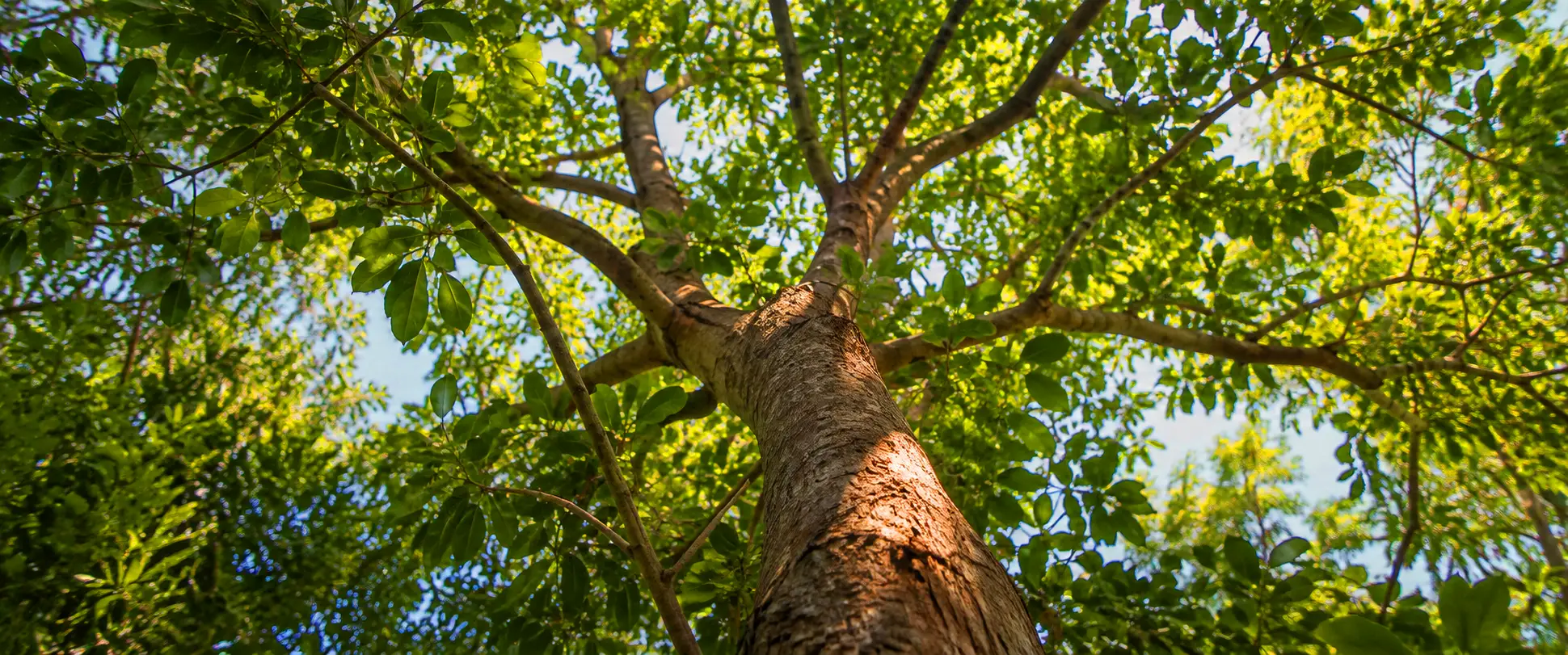
Not every part of the tree smells the same
A sandalwood trunk contains two distinct regions: the lighter outer sapwood and the darker heartwood within.
It is the heartwood that develops sandalwood's characteristic aromatic oil and lasting fragrance. As the tree matures, aromatic compounds accumulate within this inner wood.
The result is an important distinction: a sandalwood tree is not uniformly aromatic from bark to centre. The material valued for scent develops inside it over time.
The chemistry inside the heartwood
Much of the characteristic aroma of Santalum album comes from a group of naturally occurring compounds called santalols.
α-santalol and β-santalol are two of the best known. Together with other naturally occurring constituents, they are important contributors to genuine sandalwood's distinctive aroma.
Sandalwood does not smell the way it does simply because it is wood. Its aromatic character comes from compounds concentrated within the heartwood itself.
What happens below the ground is unusual
Sandalwood is a root hemiparasite. The tree produces its own energy through photosynthesis, but its roots form specialized connections with neighbouring plants from which it can obtain part of its water and mineral nutrition.
A sandalwood tree may appear independent above ground, while beneath the soil it can be connected to other plants around it.
One tree is not identical to another
The amount and composition of aromatic oil found within sandalwood heartwood are not perfectly fixed.
The development of the tree, its age and growing conditions can influence the aromatic material that forms inside the wood.
Sandalwood is therefore a natural material, not a standardized fragrance formula. One piece of heartwood is not chemically identical to every other piece, and some variation is part of the material itself.
Two forms of the same botanical material
The physical aromatic wood itself, which can be cut, ground or powdered.
The volatile aromatic fraction obtained by distilling sandalwood heartwood.
The essential oil therefore begins with the same botanical material. It is derived from the aromatic wood, rather than being a separate plant ingredient.
Species and source matter
OLFA works with Santalum album sourced from the Mysore district of Karnataka, India.
For us, identifying a material simply as “sandalwood” is not enough.
Several different species and woods are sold under the sandalwood name. Knowing the botanical species and source helps identify what the material actually is rather than relying on a familiar common name alone.